
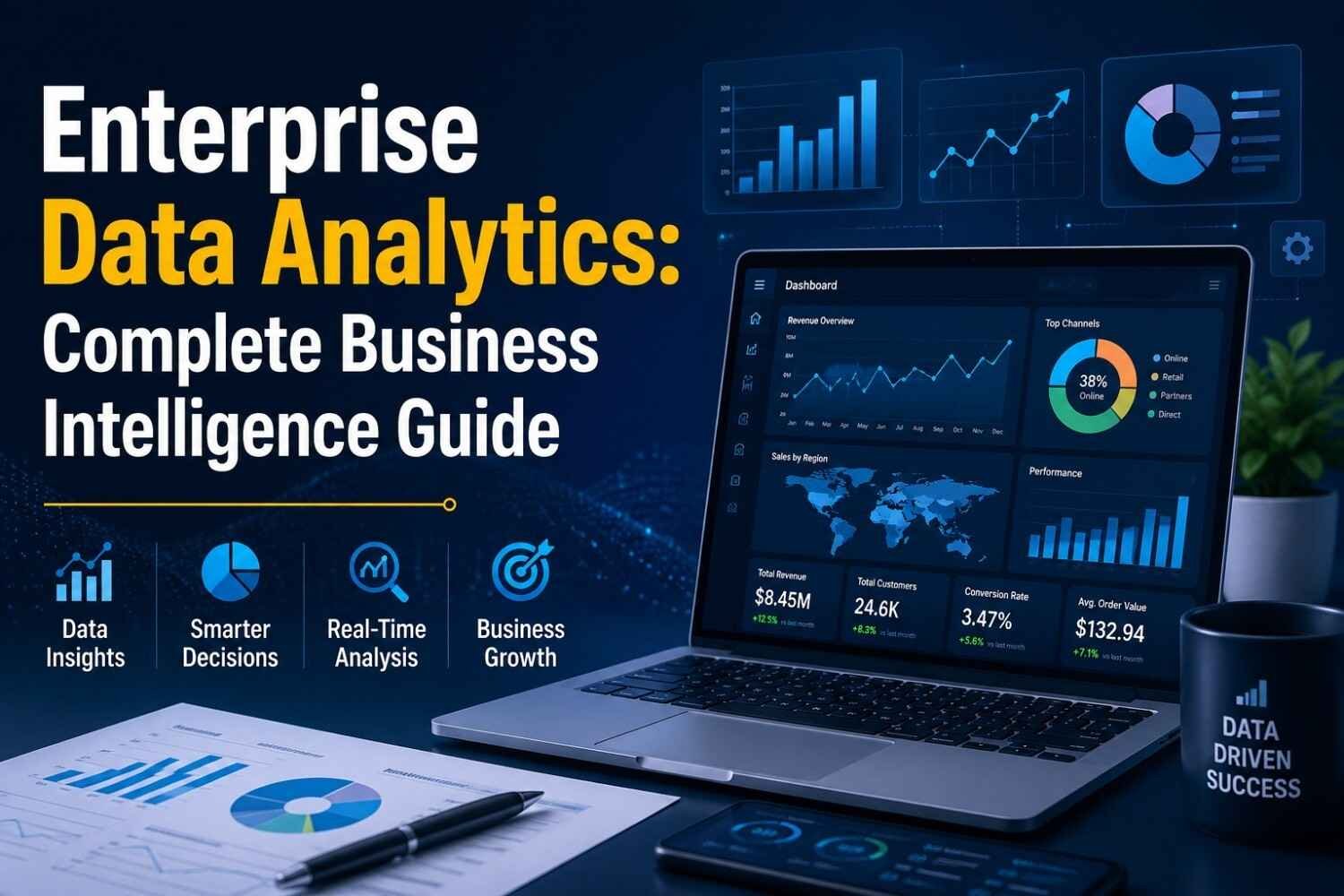
Modern businesses generate enormous amounts of information every second. Customer interactions, sales transactions, website visits, IoT devices, financial records, marketing campaigns, and operational processes all produce valuable data. However, raw data alone has little value unless organizations can transform it into actionable insights.
This is where Enterprise Data Analytics becomes essential. It enables organizations to collect, organize, analyze, and visualize data to make smarter decisions, improve operational efficiency, reduce costs, and drive business growth.
Today, enterprise analytics is at the heart of Business Intelligence (BI), Artificial Intelligence (AI), Cloud Computing, and Digital Transformation, helping organizations stay competitive in rapidly evolving markets.
What is Enterprise Data Analytics?
Enterprise Data Analytics is the process of collecting, integrating, analyzing, and interpreting data from multiple business systems to support strategic decision-making.
Instead of relying on assumptions, businesses use analytics to answer important questions such as which products generate the highest profits, what marketing campaigns deliver the best ROI, which customers are likely to churn, where operational costs can be reduced, how inventory management can be optimized, and which regions produce the highest revenue.
By combining data from ERP systems, CRM platforms, financial software, supply chain applications, HR systems, and customer databases, organizations gain a complete view of their operations.
Why Enterprise Analytics Matters
Organizations today compete on data rather than intuition. Enterprise analytics helps businesses improve customer satisfaction, increase profitability, optimize marketing budgets, detect fraud, reduce operational costs, improve employee productivity, enhance supply chain efficiency, predict future demand, and improve executive decision-making.
Core Components of Business Intelligence
- Data Collection – Gathering data from CRM, ERP, HR, accounting, marketing platforms, websites, mobile applications, and external sources.
- Data Warehousing – Centralizing business information into a secure repository for reporting and analysis.
- Data Integration – Combining information from multiple departments into a unified dataset.
- Data Cleaning – Removing duplicates, correcting errors, and standardizing formats to ensure data quality.
- Data Visualization – Interactive dashboards and reports help decision-makers understand trends quickly.
- Reporting – Automated reports deliver real-time insights to executives, managers, and analysts.
Types of Enterprise Analytics
Descriptive Analytics
Explains what happened. Examples include monthly revenue reports, sales performance, and customer acquisition.
Diagnostic Analytics
Explains why something happened. Examples include revenue decline analysis, marketing performance evaluation, and customer churn analysis.
Predictive Analytics
Uses machine learning and historical data to forecast future outcomes such as demand forecasting, inventory planning, and customer lifetime value prediction.
Prescriptive Analytics
Suggests the best actions based on predictive models, including dynamic pricing, route optimization, and personalized product recommendations.
Best Business Intelligence Tools
- Microsoft Power BI
- Tableau
- Qlik Sense
- Looker
- SAP BusinessObjects
- Oracle Analytics Cloud
- IBM Cognos Analytics
- MicroStrategy
- Sisense
- Domo
Cloud Analytics vs Traditional Analytics
| Feature | Cloud Analytics | Traditional Analytics |
|---|---|---|
| Deployment | Cloud-based | On-premises |
| Scalability | High | Limited |
| Initial Cost | Lower | Higher |
| Maintenance | Managed by provider | Managed internally |
| Accessibility | Anywhere | Office network |
| Updates | Automatic | Manual |
| Disaster Recovery | Built-in | Organization-managed |
Artificial Intelligence in Enterprise Analytics
Artificial Intelligence enhances traditional analytics by enabling automated insights, anomaly detection, predictive forecasting, natural language queries, customer segmentation, recommendation engines, intelligent automation, and real-time decision support.
Future Trends
- Generative AI
- Autonomous analytics
- Real-time streaming analytics
- Edge analytics
- Data fabric architectures
- Data mesh
- Embedded analytics
- Conversational BI
- Augmented analytics
- Hyperautomation
Frequently Asked Questions (FAQs)
What is Enterprise Data Analytics?
Enterprise Data Analytics is the practice of collecting, integrating, analyzing, and visualizing business data to support informed decision-making.
Why is Business Intelligence important?
Business Intelligence transforms raw data into meaningful insights that help organizations improve efficiency, profitability, and strategic planning.
What are the most popular BI tools?
Popular BI platforms include Microsoft Power BI, Tableau, Qlik Sense, Looker, Oracle Analytics Cloud, SAP BusinessObjects, IBM Cognos Analytics, and Sisense.
Conclusion
Enterprise Data Analytics has become a strategic necessity for organizations aiming to thrive in a data-driven economy. By integrating Business Intelligence, AI-powered analytics, cloud technologies, and robust data governance, businesses can transform raw information into actionable insights that improve efficiency, strengthen customer relationships, and drive sustainable growth.
Whether you're modernizing legacy reporting or building an AI-first analytics strategy, investing in enterprise data analytics today positions your organization for smarter decisions and long-term competitive success.